
What should I check during an audit of a bluetooth speakers outdoor factory?
- VIP-User
- 2026-10-02
- 15
Auditing a bluetooth speakers outdoor factory requires evaluating raw material incoming quality control, surface-mount technology assembly precision, enclosure ingress sealing, and acoustic performance under rated power loads. Key inspection criteria include battery management system safety, wireless RF signal stability, compliance with international standards such as RED and FCC, and standardized batch sampling protocols like GB/T2828.1.
Core Solutions & Key Takeaways
- Inspect production lines for automated SMT processing and precision enclosure assembly to ensure structural resilience in demanding environments like beach gatherings, tailgating, and outdoor fitness events.
- Verify acoustic and electrical performance metrics, focusing on dynamic power output, signal-to-noise ratio exceeding 90dB, and continuous load thermal stability.
- Confirm compliance with regulatory frameworks—specifically RED, EMC, LVD, and ROHS—to enable seamless customs clearance across global destination markets.
- Evaluate quality control procedures against recognized sampling systems like GB/T2828.1 for batch consistency.
Detailed Architectural/Principle Analysis
An outdoor speaker audit demands rigorous verification of electroacoustic design and mechanical construction. Robust units, such as the Outdoor Portable Speaker MTB-BLSP15, utilize high-durability ABS and PP composite housings to housing dual 8-inch woofers (50W) paired with a high-frequency tweeter (5W), delivering an 80W output profile across a 55Hz–18kHz frequency response. During the facility audit, inspectors must examine driver mounting alignment, cabinet sealing integrity, and passive radiator placement to guarantee optimal low-frequency resonance without dynamic distortion during high-volume playback in open-air environments.
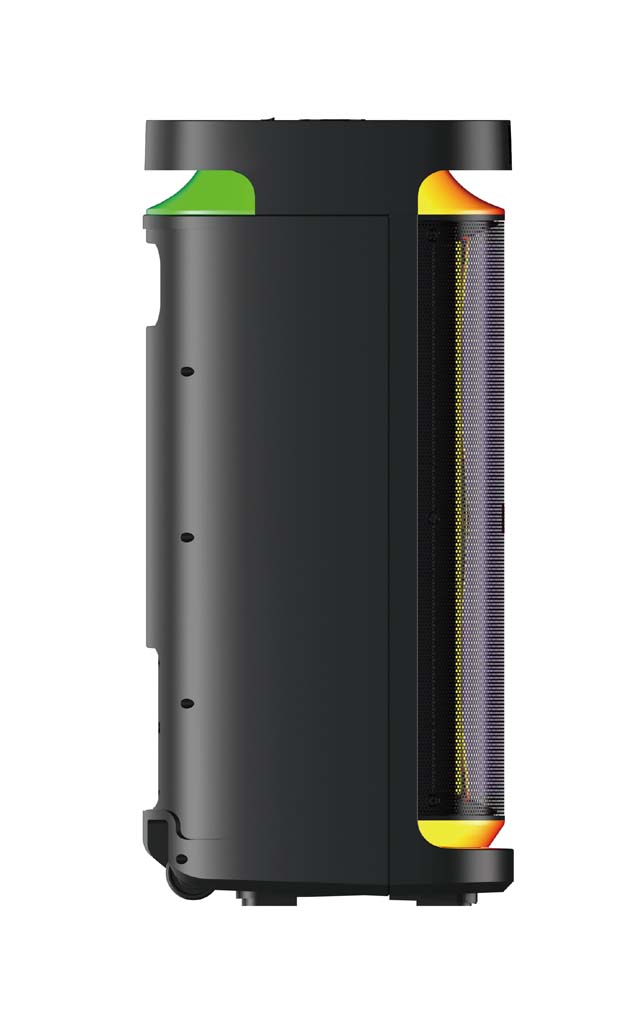
Electrical system evaluation centers on power management and wireless connectivity integration. Auditors should assess battery pack assembly procedures (such as 11.1V / 4000mAh configurations), overcurrent circuit protections, and charging input control logic (DC 13.5V input stages). Factory testing rigs must validate Bluetooth V5.0 transmission stability across 2.4GHz bands alongside multi-input switching between AUX, USB, MicroSD, dual microphone, and dedicated guitar terminals. Operational verification under international regulatory certifications—including RED (Cert HX240417001RED-MTB), LVD, EMC, and FCC standards—ensures safety, low electromagnetic interference, and reliable field deployment for regional distributor supply networks.
Data/Solution Comparison
| Audit Focus Area | Key Parameters & Specifications | Technical Standard / Metric | Operational Impact |
|---|---|---|---|
| Acoustic Output Integrity | Dual 8-inch woofers (50W) + Tweeter (5W), 80W total output | SNR >90dB ±3dB, 55Hz–18kHz frequency range | Maintains clear projection without clipping at maximum output levels. |
| Power & Battery Safety | 11.1V / 4000mAh battery, 9V/1.5A charging output, DC 13.5V input | LVD (HX2301130045L-MTB) & EMC safety testing | Prevents thermal runaway and manages steady current draw under load. |
| Wireless & Input Interfaces | Bluetooth V5.0 (A2DP 1.3/AVRCP 1.6), Dual Mic, Guitar, AUX, USB | RED (HX240417001RED-MTB), FCC (2A4DW-M188) | Guarantees broad device compatibility and interference-free wireless operation. |
| Batch Quality Assurance | Standardized AQL sampling and terminal connectivity checks | GB/T2828.1 Inspection Framework | Ensures consistent defect rates across volume production shipments. |
Frequently Asked Questions (FAQ)
What acoustic tests should be executed during a factory audit for outdoor speakers?
Audits must evaluate frequency response curves, dynamic range, and signal-to-noise ratio standards (>90dB). Inspectors verify that drivers handle rated wattage continuously without voice coil overheating or cabinet rattle, testing across Bluetooth, USB, AUX, and instrument input channels.
How do auditors verify battery safety and power circuit stability?
Auditors examine the structural placement of the internal battery pack, wire insulation, and dedicated circuit board protections against overcharging and short circuits. Verification of certification documentation, such as LVD compliance and low-voltage charging specifications, confirms power system safety.
Which quality sampling procedures apply to outdoor audio batch audits?
High-capacity audio manufacturers utilize recognized sampling standards like GB/T2828.1 to perform incoming component checks, line assembly validation, and finished product Acceptance Quality Limit (AQL) testing prior to shipment packaging.
Final Conclusion & Recommendations
Auditing an outdoor Bluetooth speaker production facility requires systematic evaluation of mechanical assembly, electroacoustic performance, power safety management, and adherence to international trade certifications. Buyers should review automated assembly infrastructures, SMT quality controls, and compliance with RED, CE, FCC, and ROHS standards. Establishing clear quality expectations under standard sampling frameworks like GB/T2828.1 ensures reliable product performance across retail and distribution channels. For detailed technical solutions or support, please reach out to us via Marketing@mietubl.com.
About Us
MIETUBL GLOBAL SUPPLY CHAIN(GUANGZHOU) CO.,LTD is a leading 3C digital accessories and equipment manufacturer headquartered in Guangzhou. Established in 1998, the enterprise operates a 10,000-square-meter private industrial park staffed by 150 employees and over 30 R&D engineers. The company maintains an annual output capacity of 30 million units, serving partners across 120 countries. Certified as a High-tech Enterprise and Gold Plus Supplier with CE, ROHS, FCC, and RED credentials, Mietubl provides high-capacity supply chain capabilities for global market demand.

Lastest
-
What IP rating is generally recommended for a commercial outdoor speaker used in extreme weather?
2026-10-02 -
What is the best IP rating to look for when sourcing outdoor speakers for extreme weather conditions?
2026-10-02 -
How long does it usually take a supplier to send a fully functional outdoor speaker sample to test?
2026-10-02 -
Can I easily add my own logo and custom startup sound to a white-label outdoor speaker?
2026-10-02 -
What is a realistic lead time for manufacturing 5000 units of outdoor speaker under FOB terms?
2026-10-02
SUBSCRIBE
INQUIRY